
The Role of the Assistive Technology Professional (ATP) in Your Power Chair Selection
Key Takeaways
- Certified Expertise: ATPs must pass a rigorous national exam and maintain ongoing education in biomechanics, seating, and electronics.
- The “Team” Approach: An ATP works alongside your Physical Therapist (PT) or Occupational Therapist (OT) to ensure your powerchairs meet both medical and technical goals.
- Insurance Requirement: For Group 3 and complex medicare approved power wheelchairs, Medicare requires the in-person involvement of a RESNA-certified ATP.
- Custom Configuration: The ATP is responsible for the precise measurements and programming that make a heavy duty power chair or complex rehab chair safe and functional.
- Training & Fitting: Beyond selection, the ATP provides the final fitting and essential driver training to ensure you can operate your device safely in your home.
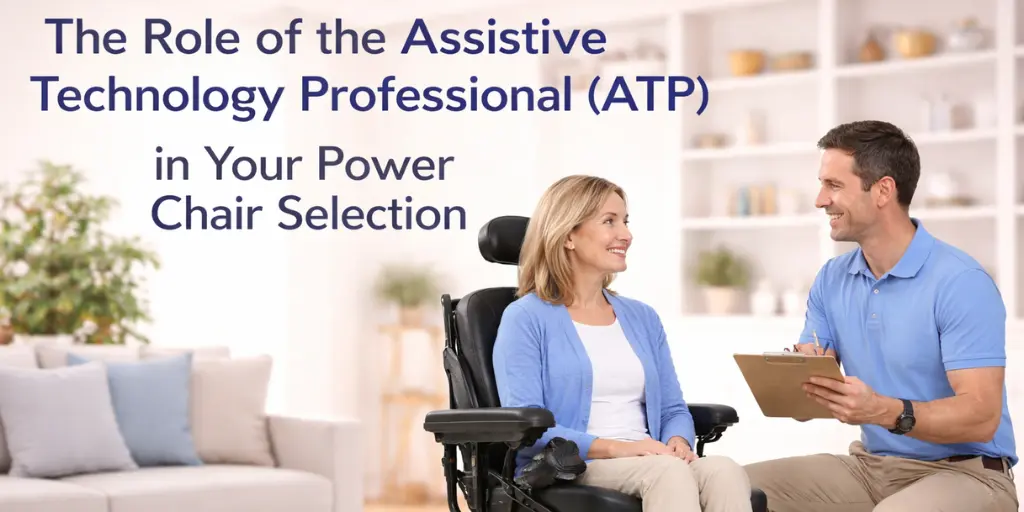
When selecting a power wheel chair, the process involves much more than simply choosing a model from a catalog. For those with complex mobility needs, the most important person in the room is often the Assistive Technology Professional (ATP).
An ATP is a highly trained specialist certified by RESNA (Rehabilitation Engineering and Assistive Technology Society of North America). They serve as the technical bridge between your medical diagnosis and the physical equipment that will support your life. This guide explains why their involvement is not only a clinical benefit but often a legal requirement for insurance coverage in 2026.
What Does an ATP Actually Do?
The role of an ATP is to “tailor-fit” technology to the individual. They are the only professionals qualified to translate a complex prescription into a finished piece of medical equipment.
To find out more about the high-tech options available for customized mobility, read our Specialized Drive Controls for Power Chairs: A Simple Guide and discover how alternative interfaces can restore your independence
1. The Specialty Evaluation and "Mat Exam"
During your mobility evaluation, the ATP often performs what is known as a “mat exam.” This involves assessing your posture while lying flat and sitting up to determine the exact angles needed for your seat and backrest. They analyze your skin integrity to prevent pressure injuries and determine if you need specialized features like power tilt, recline, or seat elevation. If you cannot use a standard joystick, the ATP is the expert who configures alternative “specialty drive controls,” such as head arrays, chin controls, or sip-and-puff systems.
2. Environmental and Home Assessment
A powered wheelchair must work within the context of your daily life. The ATP evaluates your home environment to ensure the chair can navigate your specific doorways, floor types, and van ramps. They look for “tight spots” and verify that the turning radius of the selected powerchairs will allow you to access the kitchen, bathroom, and bedroom independently. This assessment is a critical part of the documentation required to prove the chair is “reasonable and necessary” for home use.
3. Technical Programming and Custom Fitting
Once your chair is manufactured and arrives, the ATP handles the critical “fitting” stage. This involves more than just adjusting the footrests. The ATP uses specialized software to program the electronics of the power wheel chair—adjusting speeds, acceleration, and joystick sensitivity to match your reaction time. They ensure that custom-molded backrests and pressure-relieving cushions are positioned to provide the “gold standard” of postural support, which can even improve respiratory and digestive function
Why Medicare Mandates an ATP in 2026
Medicare and private insurance providers view complex rehab technology (CRT) as a long-term medical investment. To ensure these high-cost devices are prescribed correctly and prevent equipment abandonment, they have established strict mandates.
- The Law: For Group 3 powerchairs (designed for neurological conditions like ALS, MS, or Spinal Cord Injuries), the wheelchair supplier must employ a RESNA-certified ATP. This professional must have “direct, in-person involvement” in the selection process. An ATP cannot simply “sign off” on paperwork; they must physically interact with the patient.
- The Specialty Team: To ensure objective care, the evaluating therapist (PT/OT) must be independent of the wheelchair supplier. The ATP represents the supplier’s technical expertise, while the therapist provides the clinical justification. Together, they create the “Letter of Medical Necessity” (LMN) required for medicare approved power wheelchairs.
FAQ: The Role of the ATP
Q1: Is an ATP the same as a Physical Therapist?
A: No. While many PTs and OTs choose to earn an ATP certification, the roles remain distinct. A therapist focuses on your physical therapy goals and functional limitations, while the ATP focuses on the mechanical engineering and technical configuration of the powered wheelchair.
Q2: Do I have to pay extra to work with an ATP?
A: Generally, no. When you work with an authorized mobility provider for medicare approved power wheelchairs, the ATP’s evaluation and fitting services are bundled into the total cost of the equipment billed to insurance.
Q3: Can an ATP help me if my power chair needs repairs?
A: Yes. The ATP who helped select your chair is often the best person to troubleshoot complex issues. They understand the specific programming and custom seating components of your heavy duty power chair better than a general repair technician.
Q4: How do I verify if a professional is a certified ATP?
A: You can check the official RESNA directory online. It is important to confirm they are in good standing, as Medicare will not reimburse for a complex chair if the ATP’s certification has lapsed.
Q5: Will the ATP come to my home for the evaluation?
A: Yes. A core part of the manual wheelchair mobility tips and power chair selection process is the home assessment. The ATP must verify that your power wheel chair can be safely operated within your primary residence to meet Medicare’s “In-Home” coverage rule.